

The Iridescent Shadow Of Intelligence
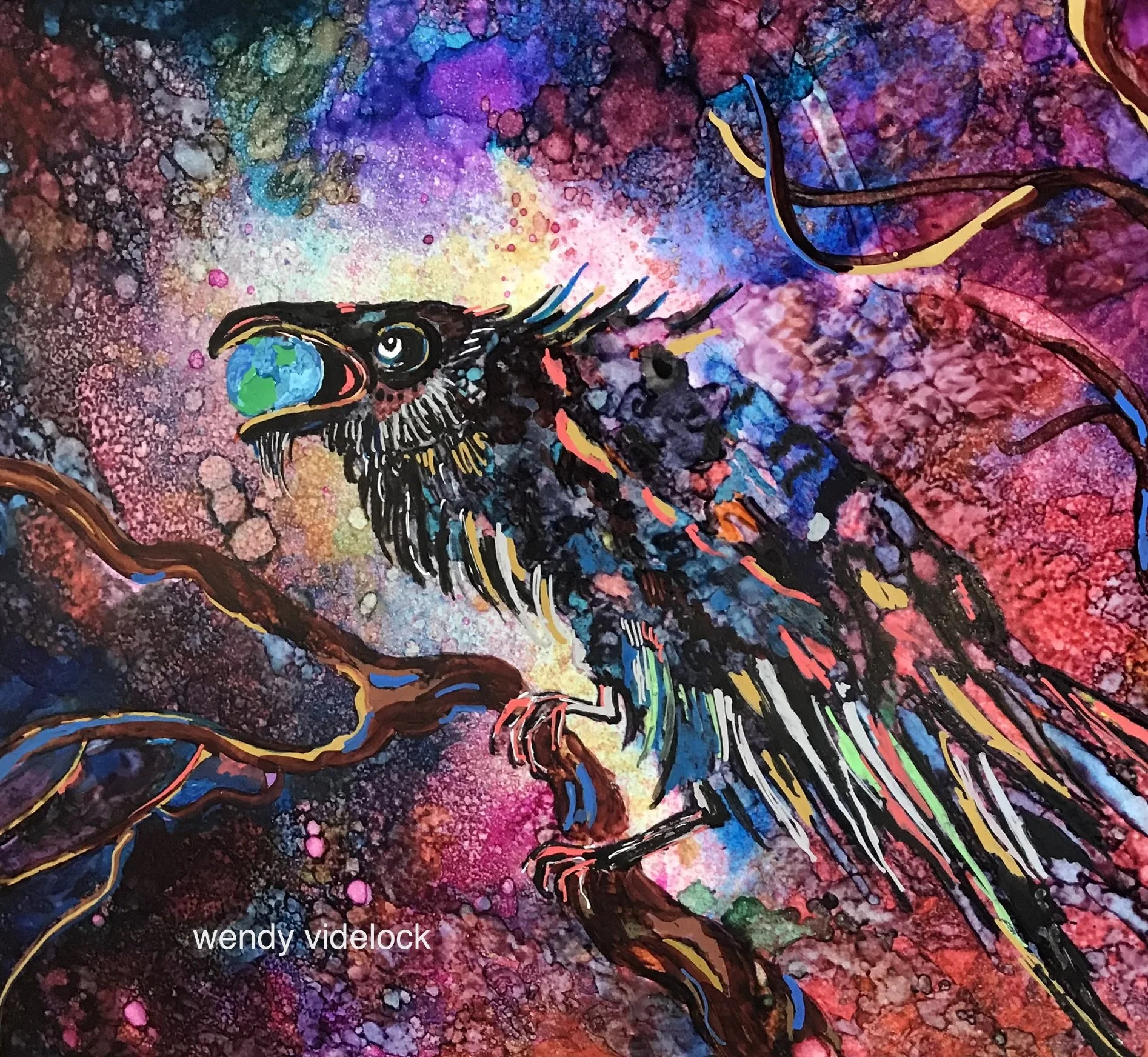
I woke this morning to a bit of rain, a couple of finches at the feeder and a raven rising up like a vision from the ravine. I was reminded of a recent trip to Yellowstone.
Yes, there were waterfalls, breathtaking views,
antelope, elk and hundreds of bison
but it was raven who returned my gaze,
raven who engaged me in conversation,
raven who captured, like a thief, my imagination.
To glimpse this great corvid in flight is to glimpse the open mind of the sky, a flicker of charisma and contradiction seems to animate each turn. Few creatures command air as ravens do — they soar, glide, tumble, dive with an acrobatic thrill and perform somersaults mid-air.
All this grace seems impossible for a bird with a chunky neck, a heavy beak and shaggy, unkempt throat feathers. This is a bird carrying an iridescent darkness, a lightness of being and an intelligence that feels both prehistoric and new, a bird of both myth and neuroscience.
As a child of the desert, the raven, much like the coyote, always seems to follow me around, reminding me of myself, sometimes appearing as a form of solidarity, other times appearing as some kind of croaking omen.
Scientists study the raven with measurement tools; the poets and myth-makers look to the same creature with jaw dropping awe. Perhaps the raven resides in both realms and challenges both science and art in large part because it refuses to be only one thing.
Science tells us the raven can solve problems, Edgar Allen Poe tells us the raven knows things we don’t and many First Nations peoples believe Raven is the trickster deity who created the world.
In Judeo Christian tradition the raven was sent by God to feed a starving Elijah, lost in the wilderness. In Norse myth, Odin’s two ravens are named Huginn (Thought) and Muninn (Memory). Inuit hunters speak of ravens as guides; where the raven flies, the caribou may follow. Clearly, the raven has captured, not just my imagination, but the collective imagination.
Even the raven’s voice is a kind of chthonic landscape of prophesy: croaks, clicks, beak-clacks, gurgles, shrill cries, rebuttals, mimicries of wind, wolves, human voices and machinery issue forth and onto the air wherever the raven is near. Whether in the white wilds of the Arctic or the dry mesas here in the Southwest, the raven arrives to say: I am here and I am watching you as you watch me.
The raven is forever wed
to the split-second moment,
the blessing and the curse
and to the deep
mysterious folds of the multiverse.
Yes, science has confirmed what the artist’s intuition has long suggested — ravens are thinkers, problem solvers, planners of the future, and even seem to understand the crafty nature of deception. In experiments, ravens stash away food while others watch — only to return later to move the stash once the observers have left the scene. This behavior requires imagining the perspective of another being, which is a skill once thought uniquely human.
A study from the University of Vienna shows that ravens can remember individual human faces for years. A raven wronged will never forget your face. A raven treated kindly might reciprocate by bringing shiny gifts. The mind behind the raven’s eye is not a blank bead of instinct but a complex system of memory, learning, emotion and curiosity.
Study after study shows a raven’s cognition is not mere mimicry, but rather a consciousness of relation, projection and possibility.
As a visual artist, I think I’ve probably sketched and painted the raven more than any other creature.
The raven has likely never heard
of shiny object syndrome
or Edgar Allen Poe
and so
I paint her on the canvas
a mystic and an alchemist.
Yet, for all their intelligence and grace, perhaps the most marvelous thing about ravens is that they play. Unabashedly. Wildly. In remarkable displays they roll around in snow, they drop sticks midair and then drop down to swoop and catch them. They surf wind currents with what can only be called expressions of joy. Ravens slide down rooftops (on plastic lids, no less) again and again, like children on sleds.
And of course they stash away shiny objects they cannot eat or use for nest making: coins, buttons, pretty stones, even bits of glass. Scientists are stumped as to why — can a bird be inspired by shiny things? I say why not?
When a raven rises up from the ravine on a cold December morning, it can change your day.
And when a raven turns her head and returns your gaze it can change your life. In this gaze we find perhaps a recognition of kinship. I’ve come to see the raven as a mirror of survival, living across time, deserts, forests and tundra, revealing all manner of experience, feeding on what remains and what might be newly discovered.
In her beautiful book, The Painted Drum, Louise Erdrich tell us that ravens are the birds she’ll miss most when she dies. She goes on to say: If only the darkness into which we must look were composed of the black light of their limber intelligence. If only we did not have to die at all. Instead, become ravens.
Indeed!
If I were a raven, I’d hush myself
and make a fuss,
alighting here,
on this delicate arch
exquisitely
weightless and robust.