

Putting Western Colorado’s Dark Skies on the Map
In Western Colorado, some of the quietest places come to life at night — but maybe not in the way you’d expect. When the sun goes down, and the streetlights don’t come on, the night sky becomes the main attraction.
“It makes you feel infinite when you can see across the sky,” says Tim Wolfe, executive director of the Colorado Tourism Office. Breathtaking views await those who seek out Colorado’s dark skies and make the time to enjoy them, and a new state program is making starry stops easier than ever to find.
THE TALE OF THE TRAIL
Colorado Stargazing Trail, a collaborative effort between Colorado Parks and Wildlife, the Colorado Tourism Office and DarkSky Colorado, rounds up all of the state’s DarkSky International-certified parks, communities and places into one convenient resource complete with links and a running event calendar.
Wolfe describes it as a “snapshot,” and the first thing viewers see on the website is a map of Colorado dotted with all of its DarkSky destinations.
While the official website launched in June, Wolfe explains the effort has been underway for a couple of years, as the Tourism Office has been helping over 50 unique partners navigate the process for DarkSky certification. The Stargazing Trail currently highlights the state’s 13 parks and eight communities that have already completed it, as well as a handful of stargazing businesses. More, Wolfe says, are still working through the requirements to make the cut.
He adds the tourism office aims to “empower the entire industry,” and the Stargazing Trail initiative was born out of an increase in local interest around stargazing tourism. For Colorado, it seems a natural fit, as the state’s high elevation, nature-centric destinations and respect for stewardship make it a perfect place to see the stars.
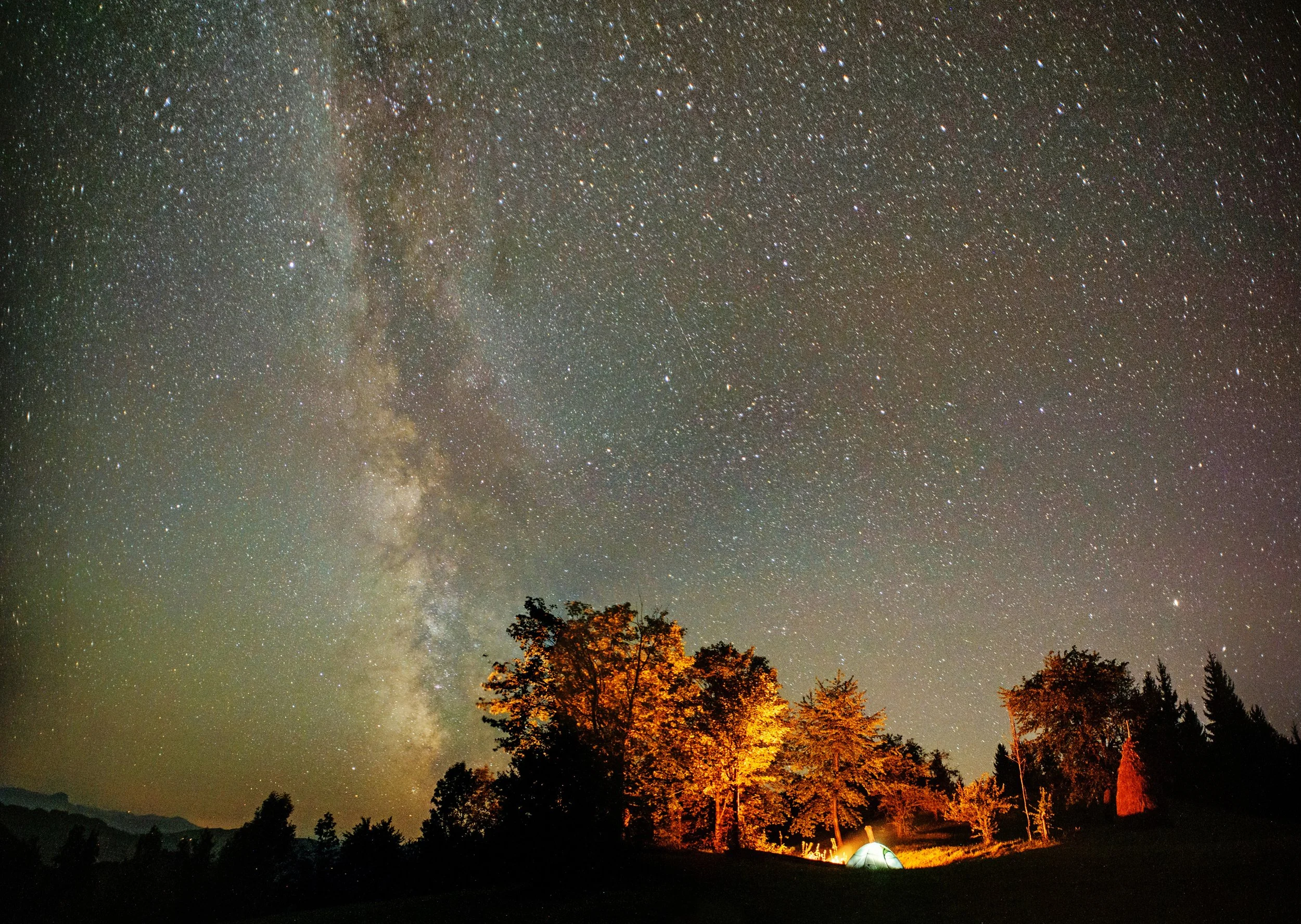
Camping under dark skies is a good way to see the Milky Way.
GOING DARK
Though some amateur astronomers end up investing in tools like telescopes or special camera lenses, you don’t need to shell out the big bucks, or anything at all, to get into stargazing. “It’s something that doesn’t cost anything,” Wolfe says, “except to be in the area or make the effort to see it.”
But, one thing is essential, and maybe we can all help protect it: a dark sky.
“It’s really a pretty special resource that we have to enjoy,” says Black Canyon Astronomical Society president Karl Wetlaufer.
He believes the new Stargazing Trail is a “fantastic” initiative and hopes it inspires people to enjoy and steward our skies, since once light pollution becomes the norm in a community, it’s hard to reel it back in.
DarkSky International sets the gold standard for minimizing such pollution, focusing on education, advocacy and outreach efforts in addition to offering certification for places that meet its rigorous requirements.
The organization advocates that light pollution doesn’t just ruin stargazing opportunities — it wastes energy and can have negative impacts on the health and wellbeing of humans and wildlife.
To earn certification, DarkSky Places must meet sky quality standards as measured by a special meter, take steps such as installing lighting that is night-sky friendly, and have a plan to continue monitoring and conserving night sky quality. The organization recognizes places ranging from state and national parks to Urban Night Sky Places and DarkSky Approved Lodging, and provides guidance on best lighting practices for everything from home fixtures to stadium lights.
This is where Wetlaufer believes everyone can make a stand for the night sky, and he encourages home and business owners to take steps like using downward-facing light shields, warmer-toned bulbs, motion-censored lights or DarkSky-recommended fixtures when possible. And, of course, turning them off when they’re not needed.
“It takes a village to preserve our night skies,” he says. But, they’re pretty magnificent when we do.
GET STARSTRUCK
When guests visit CampV, a glamping destination outside the DarkSky communities of Nucla and Naturita, owner Natalie Binder gets to watch many see the Milky Way for the first time. Some take a few moments to comprehend what they’re looking at.
“The awe and reaction are so special,” Binder says. “This would not be possible if we were not in a dark sky place.”
Here on the Western Slope, locals and guests don’t have to travel far to enjoy the darkness. In fact, the western side of the state boasts many of Colorado’s DarkSky places, such as Mesa Verde National Park, Curecanti National Recreation Area, Dinosaur National Monument and the communities of Ridgway, Paonia and Norwood, to name just a few.
“Anywhere that really made it on that map is going to be quite good,” Wetlaufer shares.
But, he added, higher-elevation areas, such as the Slumgullion Center near Lake City, can provide an extra special experience, as the atmosphere is thinner and viewers are even further above possible sources of light pollution.
“Being at high elevation can certainly improve the brightness and crispness of the stars,” he explains.
And no matter where they plan to explore, a few simple tips can help stargazers really get the most out of their experience.
One big one is to watch for the moon phase, and try to stargaze as close to the new moon
as possible, especially if you’re planning a dedicated trip.
“That bright light can actually drown out a lot of stars,” Wetlaufer says, even though it’s a natural source.
He also recommends giving the eyes some time to acclimate to the darkness and, if possible, bringing red or warm-toned headlamps or flashlights on adventures, as these won’t “reset” the eyes as much as brighter options. He noted stargazers should also bring extra layers, such as a sweatshirt or blanket, especially if they’re planning an outing at high elevation.
For those who’d like to know what they’re looking at, he adds, plenty of books, websites and apps exist to help astronomy enthusiasts make sense of the stars, and his personal favorite is called Stellarium.
Binder, however, suggests taking at least a little time to take it all in before breaking out the apps and star charts.
“Give yourself time to lie on the earth and just look up,” she says. “I think the best way to stargaze is with curiosity and wonder.”
“Get out there and enjoy it,” Wetlaufer agrees.
Originally published in the fall 2026 issue of Spoke+Blossom.