

A Solar Shift At The Storm Cellar Is Proving That The Future Of Farming Runs On Sunlight
Rows of wine grapes stretch across The Storm Cellar’s property on a hillside outside of Hotchkiss in one of the highest wine-growing regions in the world. The scorching Western Colorado desert sun beats down on the high-altitude grapes, but now, it’s not just part of the scenery; it’s reshaping an industry.
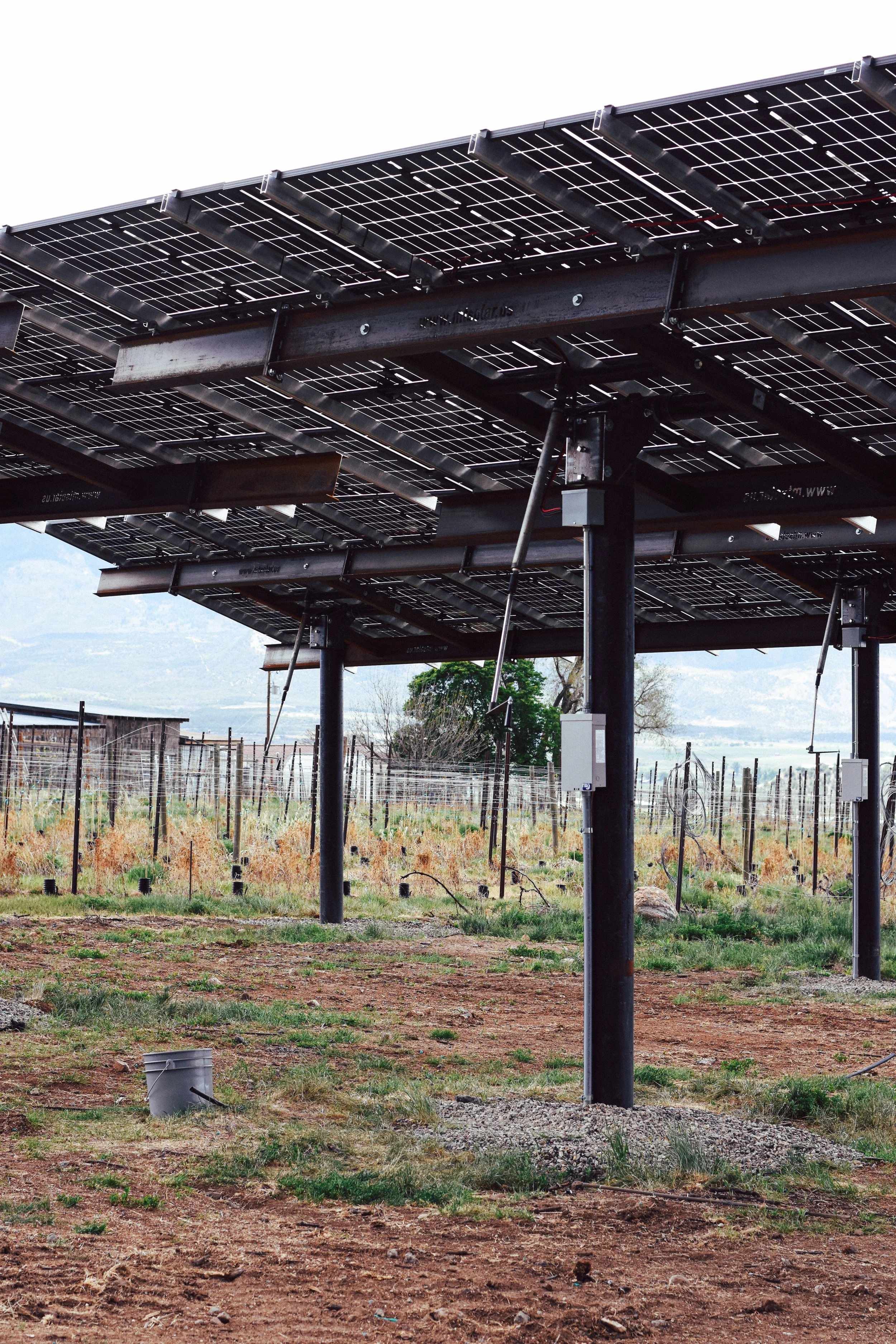
The frames and racking system are fully adjustable, allowing the angle to be modified based on the sun’s position. They also double as shade for people and future crops. Photos by Jayme Henderson.
The Storm Cellar recently integrated a state-of-the-art solar system that doesn’t just power the winery — it changes how rural agriculture thinks about energy altogether.
THE PARTNERSHIP THAT SPARKED A POWER SHIFT
Like many good stories in wine country, a conversation about solar power started over a glass of wine.
Solar had long been on the radar for The Storm Cellar co-owners Jayme Henderson and Steve Steese, but it lived in the realm of future plans. That changed during the winery’s annual Sip into Spring festival, when they met Isaac Ketcham of Atlasta Solar Center, based in Grand Junction.
What followed wasn’t just a partnership; it was alignment. “I realized that their vision to provide solar power to rural areas coincided identically with our need for a more sustainable energy solution,” Henderson explains.
Over the next year, Ketcham collaborated with the winery and an electrical engineer to design a system that would ultimately earn a $100,000 grant from the Colorado Department of Agriculture, not just for using solar, but for reimagining how it could work.
CRACKING THE POWER CODE
Many rural farms face the same problem: they operate on single-phase power, which is simpler, cheaper and, for most modern farming equipment, increasingly limiting.
Most of today’s agricultural and wine-making equipment is built for three-phase power, the global standard. This electrical mismatch can strain systems, reduce efficiency and wear down equipment faster. Upgrading to three-phase electrical service through traditional utilities is expensive upfront — and even more painful month-to-month.
Ketcham had a better solution. “The real trick of what we’re doing is a three-phase micro grid meter behind the existing single-phase meter. This allows them an unlimited power supply source, plus, they’re able to use and take back excess energy into the single-phase grid in a compliant fashion.”
Translation? The winery gets the power capacity it needs without the costly utility overhaul.
Even more impressive, Ketcham proved that solar and backup battery storage without a government tax incentive was cheaper than a traditional utility upgrade and the resulting electricity bill. That insight helped secure the state grant and positioned the project as a model for rural innovation.
SMARTER FARMING
The effects of the new system ripple through nearly every aspect of the winery.
Previously, watering required manual effort, carefully sequenced across zones. Now, a dual-pump system allows multiple zones to run simultaneously via drip irrigation, reducing runoff and increasing efficiency.
The result isn’t more water use — it’s better water use.
“We’re in the process of replanting our entire vineyard,” Henderson says. “We can’t replant as fast as possible because you have to water new vines. With this increased water delivery system, we can replant our vineyard faster, which will directly affect our bottom line.”
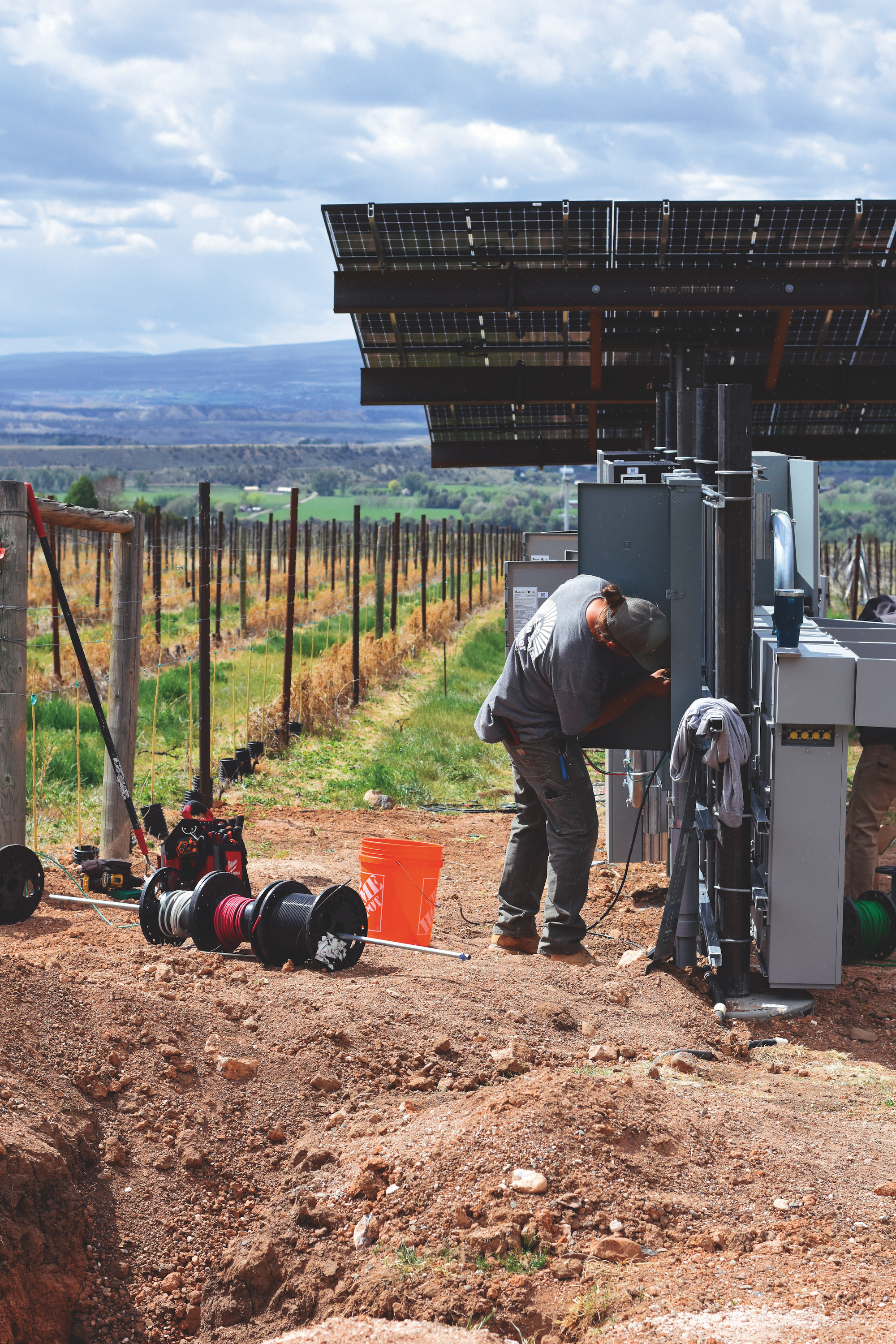
Previously, watering required manual effort, carefully sequenced across zones. Now, a dual-pump system allows multiple zones to run simultaneously via drip irrigation, reducing runoff and increasing efficiency.
Beyond the vines, storage, the tasting room and critical operations are supported by battery backup, ensuring consistency during peak summer heat. “There’s always the fear of losing power in the middle of summer. If the power doesn’t come back on, it can ruin a crop,” explains Steese.
In an industry where a missed irrigation day or power outage can jeopardize an entire crop, reliability is survival. What the system ultimately delivers isn’t just energy — it’s peace of mind.
UNEXPECTED PERKS OF GOING SOLAR
The benefits don’t stop at electricity.
The American-made steel frames and racking system are fully adjustable, allowing Steese and Henderson to modify the angle based on the sun’s position to capture more energy than a fixed roof mount. They also double as shade, protecting both crops and people from the blazing desert sun. Beneath them, the winery is experimenting with agrivoltaics, growing vegetables in filtered light while creating a naturally shaded space for outdoor gatherings.
Then there’s the broader impact. During winter months, when the winery’s energy use drops, excess power flows back into the grid, supporting nearby homes during peak heating demand.
“Energy flows on a path of least resistance,” Ketchem explains. “When excess energy generated goes to the grid, it flows to the next house and then the next. They’re powering the region this way.”
A BLUEPRINT FOR THE FUTURE OF FARMING
Farming has always been a negotiation with finite resources. The Storm Cellar leans into what Western Colorado is most abundant in: year-round sunshine. This model opens doors for rural farms to pursue energy independence. And, it offers something rare in agriculture: a glimpse of stability in an unpredictable industry.
“Every farm dreams of electrical independence,” says Steese. “The technology and implementation of this solar system will break barriers for people in rural areas and make it more accessible for farmers.”
The Storm Cellar is proving that the future of farming might not just depend on the land beneath our feet, but on the energy above it.
Originally published in the summer 2026 issue of Spoke+Blossom.